5 reasons to move to online documentation at your early childhood centre
28 June 2026 · 6 min read
Across Australia, long day care, family day care, and outside school hours care (OSHC) services are shifting away from paper-based and manual documentation systems. The demands of the National Quality Framework (NQF), the updated Early Years Learning Framework V2.0 (EYLF), and the daily realities of running a busy centre have made the case for online documentation stronger than ever.
If your centre is still relying on folders, binders, or disconnected spreadsheets, here is what you are missing.
1. Every child's learning journey in one place
Paper-based systems scatter information across folders, filing cabinets, and individual staff devices. When an educator needs to review a child's observation history before writing a learning story, or a director needs to pull together evidence for an NQS assessment visit, hunting through physical records costs real time and creates real risk.
A well-designed online documentation system brings everything together in a single, searchable location. In One Child, each child has a dedicated portfolio containing every observation, learning story, planning entry, and reflection note written about them — all chronological, all linked to EYLF or MTOP outcomes, and all accessible from any device.
Educators can see at a glance what has been documented recently, what outcomes have been covered, and where a child's learning journey is heading next. Directors can review the quality and frequency of documentation across their entire centre without touching a single folder.
This directly supports NQS Quality Area 1, which requires that each child's learning and development is assessed as part of an ongoing cycle of observation, documentation, planning, implementation, and reflection.
2. Secure, private, and hosted in Australia
Free download
80 activities, mapped to the frameworks you already use
Free download: 80 activities mapped to EYLF v2.0 and MTOP v2.0 outcomes — ready to use this week.
Documentation about children is sensitive. Parents trust your centre with some of the most personal information that exists about their child, and that trust carries legal weight under the Australian Privacy Law.
One Child takes this seriously. All data is encrypted with an SSL certificate and hosted exclusively on servers located in Australia — meaning your centre's records and children's information never leave Australian jurisdiction. This matters for compliance, and it matters for the families who trust you with their children's data.
While Australian data hosting and SSL encryption have become standard expectations in professional software, it is worth noting that not every documentation tool in the market meets this bar. It is a reasonable question to ask any provider you evaluate.
3. Families get their own private portal
When families enrol with your centre, they receive a private parent portal login — a dedicated, secure space where they can follow their child's learning journey as it unfolds.
Through their portal, parents can view learning stories and observations shared by educators, read centre newsletters, and stay connected to what is happening in their child's day. Rather than catching a brief summary at pick-up, families can engage with their child's development at a time that suits them.
This supports the EYLF V2.0 principle of partnerships with families, which recognises families as children's first and most influential educators. Visible, ongoing documentation strengthens the relationship between home and centre in a way that a paper portfolio simply cannot.
NQS 1.3.3 requires that families are informed about the program and their children's progress. A private parent portal makes this effortless rather than administrative.
4. Real insight into your centre's programming
One of the most underused benefits of online documentation is what it can tell you about your centre's practice over time — not just individual children, but the health of your entire program.
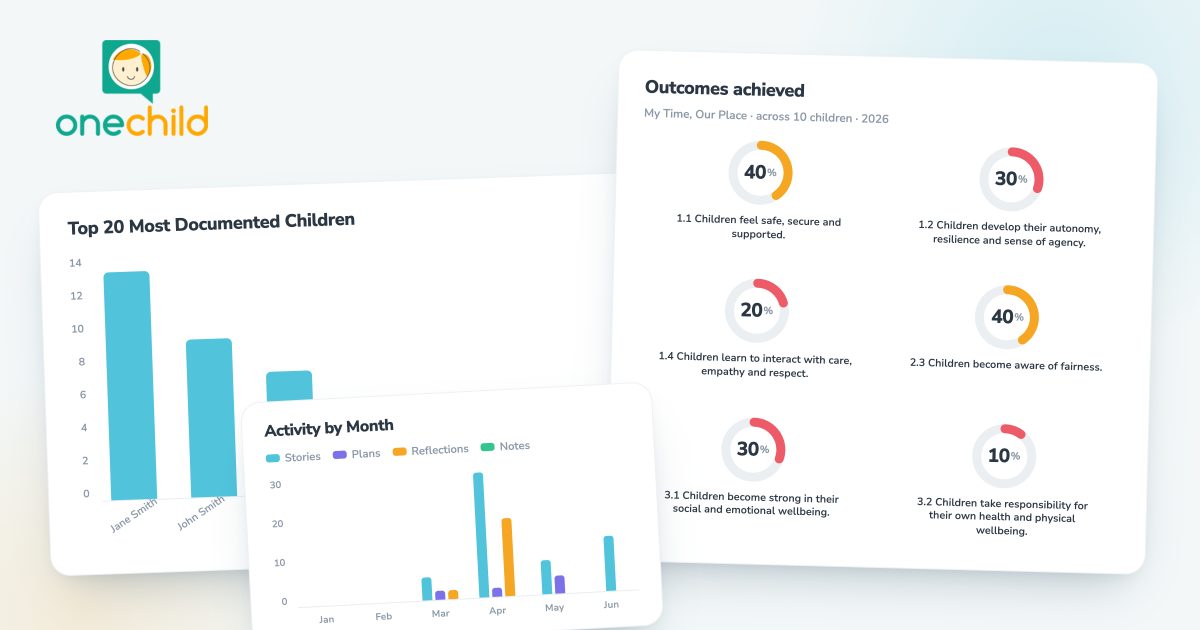
One Child's curriculum overview gives directors and educational leaders a clear, data-driven picture of how their service is performing. Choose a year and a framework — EYLF or MTOP — and One Child calculates outcome coverage as a percentage across your active enrolments, displayed as a visual donut chart for each of the five learning outcomes. You can see immediately whether your programming is delivering balanced coverage or clustering around familiar activities.
The reporting goes further. The story count section shows the 20 most documented children in a bar chart, a ranked list of the top 20 with story counts, and — critically — a list of children who have had no documentation in the past three months. No child falls through the cracks unnoticed.
Educator reporting gives you a bar chart of each educator's documentation output for the year, with separate counts for learning stories, planning entries, and reflections. And a month-by-month overview tracks all four documentation types — stories, plans, reflections, and notes — across the entire centre for the year.
This is the kind of evidence that supports continuous improvement under the NQF, and the kind of visibility that makes preparing for an NQS assessment visit considerably less stressful.
5. It saves time — and time is everything in early childhood
Educator workload is one of the most persistent challenges in the early childhood sector. Documentation is non-negotiable, but when it becomes a source of stress and after-hours overtime, it undermines the practice it is meant to support.
Online documentation streamlines the entire process. Forms are pre-structured to meet NQF requirements. Linking observations to EYLF or MTOP outcomes takes seconds. Sharing a learning story with a family is a single action rather than a physical handover or a printed copy slipped into a bag.
One Child's AI-assisted learning story feature — our newest addition — takes this further. Educators can draft a learning story from their observations in moments, with the AI suggesting language and structure while the educator retains full professional judgement over the final piece. It is not about replacing the educator's voice. It is about removing the blank-page problem that makes documentation feel harder than it needs to be.
Making the switch
The move to online documentation is not simply a technology upgrade. It is a shift in how your centre approaches the entire planning cycle — making it more consistent, more visible, and more useful to everyone involved, from educators to families to assessors.
One Child has supported Australian early childhood centres since 2012. Our flat-rate pricing means your subscription cost never increases as your enrolments grow — a deliberate choice in a market where most platforms charge per child.
Ready to see what One Child looks like in your centre?
Free download
80 activities, mapped to the frameworks you already use
Free download: 80 activities mapped to EYLF v2.0 and MTOP v2.0 outcomes — ready to use this week.
More in Software & Tools
View all Software & Tools articles →
Best Childcare Documentation Software in Australia (2026 Comparison)
A fair comparison of the best childcare documentation software in Australia for 2026, covering pricing, features, OSHC support and who each...
04 Jul 2026 · 7 min read

One Child vs Educa: An Honest Comparison for Australian Childcare Services
Comparing One Child and Educa for Australian childcare documentation. Flat rate by approved places vs per-child tiered pricing with add-ons,...
04 Jul 2026 · 8 min read
One Child vs Kinderloop: An Honest Comparison for Australian Childcare Services
Comparing One Child and Kinderloop for Australian childcare documentation. Flat rate by approved places vs $1.25 per child pricing, AI writi...
04 Jul 2026 · 7 min read