
Observation basics: a guide for early childhood educators
11 June 2026
An observation is the starting point for everything that follows in early childhood documentation. Without a quality observation, a learning story has no foundation, a planning cycle has no evidence, and a child's portfolio becomes a collection of activities rather than a genuine record of growth.
Yet for many educators, particularly those early in their careers, observations remain one of the most uncertain parts of the job. What should I be looking for? How much detail is enough? How do I link what I saw to an EYLF or MTOP outcome in a way that feels meaningful rather than mechanical?
This guide covers the fundamentals: what observations are for, what to observe, the different types you will use, how to write them well, and how to make your outcome links count.
What is an observation, and what is it for?
An observation is a written record of something a child said, did, or experienced that is worth capturing. It is a professional record, not a diary entry. Its purpose is to document evidence of a child's learning and development that can be used to inform future programming, build a portfolio, share progress with families, and demonstrate quality practice under the National Quality Standard.
Under NQS Quality Area 1, every child's learning must be assessed as part of an ongoing cycle of observation, planning, implementation, and reflection. The observation is where that cycle begins. Without it, the rest of the cycle has nothing to work from.
Both the Early Years Learning Framework V2.0 (EYLF Belonging, Being and Becoming) for long day care and My Time, Our Place (MTOP) for outside school hours care (OSHC) treat observation as central to understanding and responding to each child's learning. The framework is different, the age group is different, but the discipline of watching carefully and recording meaningfully is the same.
What should you observe?
Not everything that happens in a room needs to be documented. A good observation captures something that is worth capturing, a moment that reveals something about a child's development, interests, relationships, or thinking that would not otherwise be recorded.
Ask yourself these questions before you begin writing:
Does this moment tell me something about this child that I did not already know, or confirm something I have been watching develop? Does it connect to one of the learning outcomes in the framework your centre follows? Would a parent reading this understand something new or meaningful about their child? Would this be useful for informing what I plan next for this child or group?
If the answer to any of these is yes, it is worth documenting.
This does not mean every observation needs to be a major insight. A small moment of persistence, a new social interaction, a question a child asked that revealed their thinking, all of these are legitimate. What matters is that the observation has a reason behind it, not just a description of activity.
The difference between a thin observation and a quality one
The most common problem with early childhood observations is that they describe what happened without explaining why it matters. Consider this example:
"Jake demonstrated fair behaviour while playing games on the computer."
This is a comment, not an observation. It tells the reader almost nothing. Who was Jake playing with? What did fairness look like in that moment? What did he say or do? Why did this stand out?
Now compare it to this version of the same event:
"On Thursday Jake and Sam asked if they could set up the computer to play the racing car game. Jake had played this game before but Sam had not. Jake showed Sam how to choose a car and customise it for best performance. When both cars were ready to race, Jake asked Sam 'Would you like to go first?' Sam agreed and went first. When Sam had finished Jake said 'Good try.' Jake then had a go and showed Sam how to skid around corners to keep his speed up and get a better time. The two boys had several more turns each until their computer time limit was reached. Jake showed great maturity and demonstrated his awareness of fairness in helping Sam, linking to EYLF Outcome 2.3, children become aware of fairness."
The difference is specificity. The second version gives the reader the whole picture. The conversation, the actions, the sequence of events, and the educator's professional interpretation. A parent reading this knows exactly what happened and why the educator found it significant. An assessor reading this sees an educator who understands the framework and applies it with genuine insight.
Detail is what separates documentation that builds a meaningful portfolio from documentation that fills one.
Types of observations
Educators use different observation formats depending on what they are capturing and how much time they have available. Understanding when to use each type makes your documentation more versatile and more useful.
Anecdotal observation
The most common type. A narrative account of a specific event or interaction, written after the fact from memory or quick notes taken in the moment. Anecdotal observations are flexible and can range from a few sentences to several paragraphs depending on the complexity of what was observed. The Jake and Sam example above is an anecdotal observation.
Learning story
A longer, more narrative form of documentation that tells the story of a child's learning experience from the educator's perspective. Learning stories typically include the observation, an interpretation of what the learning reveals, outcome links, and sometimes a reflection or next steps for planning. They are more personal in tone than an anecdotal observation and are particularly effective for sharing with families.
Running record
A continuous, detailed account of everything a child does and says during a set period of time, written as it happens. Running records are time-intensive but produce rich data about a child's behaviour, language, and interactions. They are particularly useful when you are trying to understand a pattern or build a detailed picture of a specific child over a short period.
Jotting or quick note
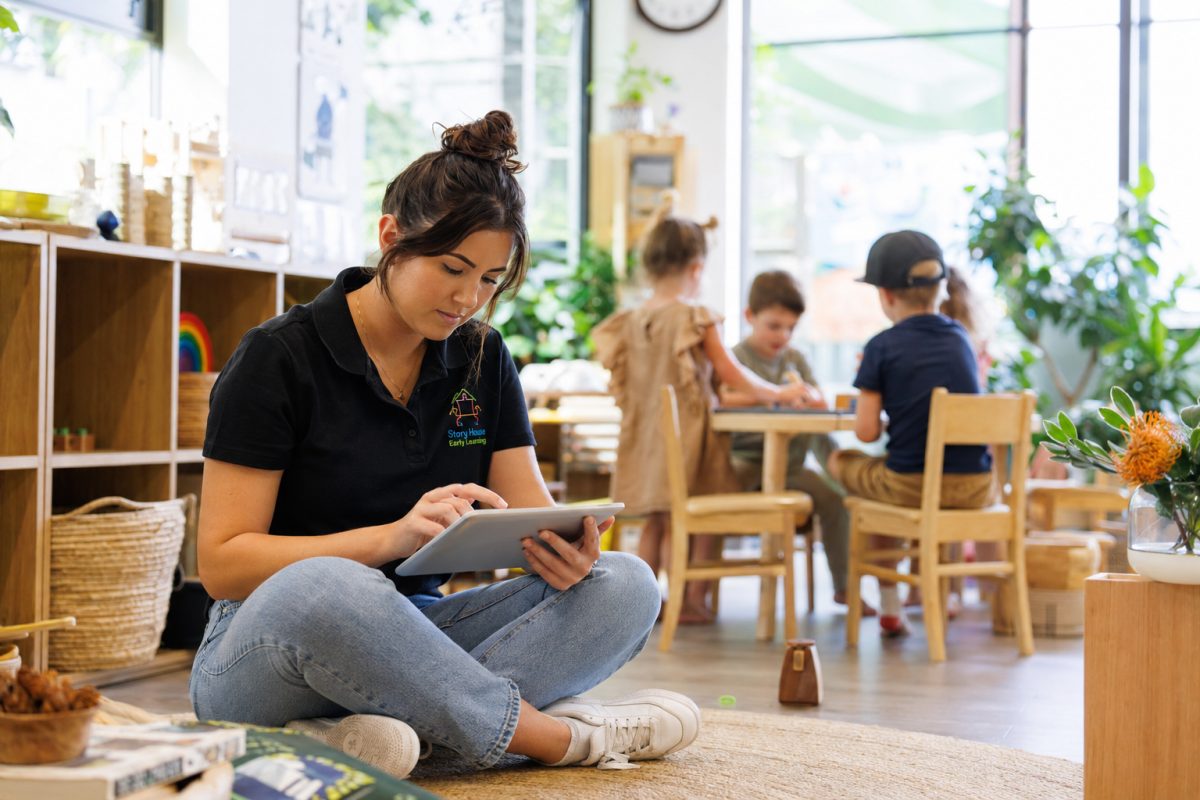
A brief capture of something observed in the moment, intended to be expanded later. A few sentences on a phone or tablet, a photo with a caption, a voice memo. Jottings are not finished documentation but they are the raw material that makes finished documentation possible, particularly in busy rooms where extended writing time is not available.
Work sample
A piece of a child's work, whether a drawing, a construction, a piece of writing, or a photograph of something they made, accompanied by an educator's written interpretation. Work samples are particularly effective in OSHC settings where school-age children produce tangible outputs that can be documented alongside the learning they represent.
How to link observations to outcomes meaningfully
Every observation should be linked to at least one outcome from the relevant framework. For long day care this means the five learning outcomes of EYLF V2.0 under Belonging, Being and Becoming. For OSHC services this means the five outcomes of My Time, Our Place. Both frameworks share the same five outcome areas, though the descriptors and indicators reflect the different developmental stages of the children involved.
The five outcome areas across both frameworks are:
- Children have a strong sense of identity
- Children are connected with and contribute to their world
- Children have a strong sense of wellbeing
- Children are confident and involved learners
- Children are effective communicators
A meaningful outcome link does two things. It names the outcome and it explains the connection. Writing "EYLF Outcome 4" tells the reader which outcome you chose. Writing "I linked this to EYLF Outcome 4 because Mia's persistence in trying different approaches to solve the puzzle shows her developing learning dispositions, particularly her willingness to take on challenges" tells them why, and demonstrates genuine professional understanding.
Be selective with outcome links. Choosing one or two outcomes and explaining them well is more valuable than listing four or five without explanation. The planning cycle that follows an observation is only as useful as the clarity of the outcome links within it.
Observations as the start of the planning cycle
An observation is not an end in itself. It is the beginning of a cycle. What you observe informs what you plan next, whether that is extending an interest a child has shown, providing support in an area where they are developing, or building on a social dynamic you noticed between a group of children.
This is where the quality of your observation has a direct impact on the quality of your programming. A thin observation gives you little to work with. A detailed, outcome-linked observation tells you exactly what this child is ready for next and why.
Responsive programming, where the program is shaped by what you observe about each child rather than by a fixed schedule of activities, is a core expectation under the NQF. NQS 1.2.2 requires that educators respond to children's ideas and play and extend their learning accordingly. Strong observations give you the evidence to do that well. Weak ones make it guesswork.
Building the habit
Observation is a skill, and like all skills it develops with practice and feedback. Educators who write observations regularly, reflect on them honestly, and seek feedback from their educational leader or colleagues improve steadily over time.
A few habits that support this development: write notes in the moment even if the full observation comes later, read back your observations before submitting and ask whether they would make sense to someone who was not there, and review your portfolio coverage periodically to check that all children are being observed and that your outcome links are balanced across the framework.
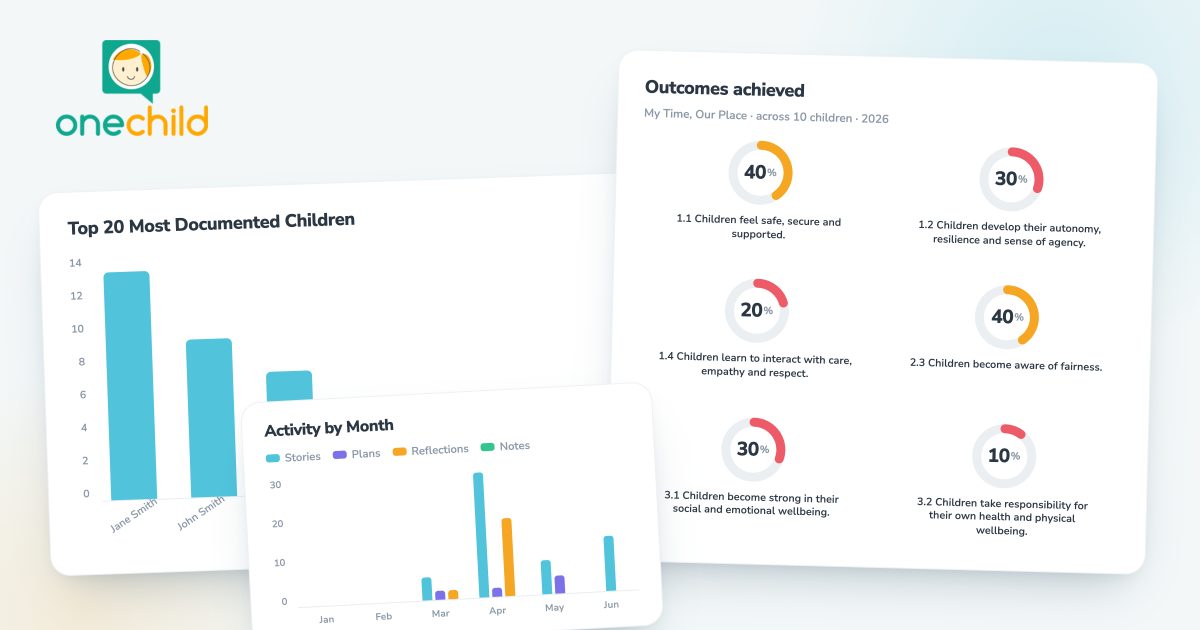
One Child makes this easier in practice. Observations can be started on any device, saved in draft, completed later, and linked to outcomes with a few taps. The curriculum overview shows you at a glance which outcomes are covered and which children have not been documented recently, so nothing falls through the cracks. And the AI-assisted learning story feature helps educators who find the blank page difficult by generating a draft from observation notes that the educator then shapes into their own voice.
Where to from here
If you are new to observations, start with anecdotal notes and focus on one thing: enough specific detail that someone who was not there could picture exactly what happened. That discipline alone will lift the quality of your documentation significantly.
If you are more experienced, the next level is the deliberateness of your outcome links and how clearly your observations feed into your planning cycle. That connection, from what you see to what you plan, is where the real quality of early childhood practice lives.
One Child is built around exactly this cycle, from observation to story to plan to reflection, all in one place.
Related Articles
5 reasons to move to online documentation at your early childhood centre
Still managing documentation on paper or spreadsheets? Here are five compelling reasons Australian early childhood centres are switching to...
10 June 2026
7 steps to better documentation in early childhood education
Good documentation is more than compliance. It tells the story of a child's learning journey. Here are seven practical steps to help your ed...
10 June 2026

8 ways to motivate educators to document
Documentation is a non-negotiable part of quality early childhood practice, but getting educators genuinely motivated to do it well is one o...
10 June 2026