Finding time to document for the NQF
11 June 2026
Ask any early childhood educator what stops them from documenting as often or as well as they would like, and the answer is almost always the same: time. The children need supervision. There are meals to prepare, transitions to manage, families to greet, and a hundred small things that need attention in any given hour. Documentation, which requires sustained thought and writing, can feel like it belongs to a quieter version of the job that does not quite exist.
This is true whether you work in long day care, family day care, or outside school hours care (OSHC). The setting changes, the age of the children changes, and the framework changes, but the time pressure is universal. Long day care and family day care services document against the Early Years Learning Framework V2.0 (EYLF, Belonging, Being and Becoming), while OSHC services work within My Time, Our Place (MTOP). Both frameworks require the same ongoing cycle of observation, planning, and reflection under NQS Quality Area 1.
The reality is that documentation is not optional regardless of which framework you follow. NQS Quality Area 1 makes clear that every child's learning and development must be assessed as part of an ongoing cycle of observation, planning, implementation, and reflection. The question is not whether to find time for documentation, but how.
Here are practical strategies that work in real centres, not in theory.
Build documentation into the roster, not around it
The single most effective thing a director or coordinator can do to improve documentation output is to treat it as a rostered responsibility rather than something educators squeeze in between other duties.
This does not necessarily mean adding hours. It means being intentional about when documentation happens. Some long day care centres build a fifteen to thirty minute block at the start or end of a shift specifically for documentation. Others designate a quieter period in the day, typically during a rest period or when a group of children is engaged in an independent activity, where one educator is explicitly off the floor and writing.
For OSHC services, the structure of the day creates different opportunities. The gap between the morning session ending and the afternoon session beginning can be a natural documentation window if it is protected and expected rather than consumed by setup and administration. Some OSHC coordinators build documentation time into the transition period at the end of the afternoon session once children have been collected.
The key is that this time is protected. It is not the time that gets pulled when ratios are short or a parent needs a longer conversation at pick-up. When documentation time is treated as optional it becomes optional. When it is built into the day with the same seriousness as any other rostered responsibility, it happens consistently.
Manage to the commitment, not just the output
Every centre has educators who document reliably and educators who find every reason not to. This is a management issue as much as a time issue, and it needs to be addressed directly.
If certain educators consistently fail to document without legitimate reason, that needs to be part of a professional conversation, not quietly ignored. When documentation is treated as optional by some members of the team, it creates resentment among those who do it regularly and erodes the culture of the whole centre.
This does not mean counting learning stories in a punitive way. It means being clear about expectations, providing support where confidence or skill is the real blocker, and following up when commitments are not met. NQS 7.2.3 requires that every educator's performance is regularly evaluated and that individual plans are in place to support their learning and development — a responsibility that sits with leadership, not just with the educator. Managing to that expectation is part of a director's or coordinator's role.
Take observations in the moment, write them up later
One reason educators feel they do not have time to document is that they imagine documentation requires sitting down and writing a complete, polished story in a single sitting. It does not.
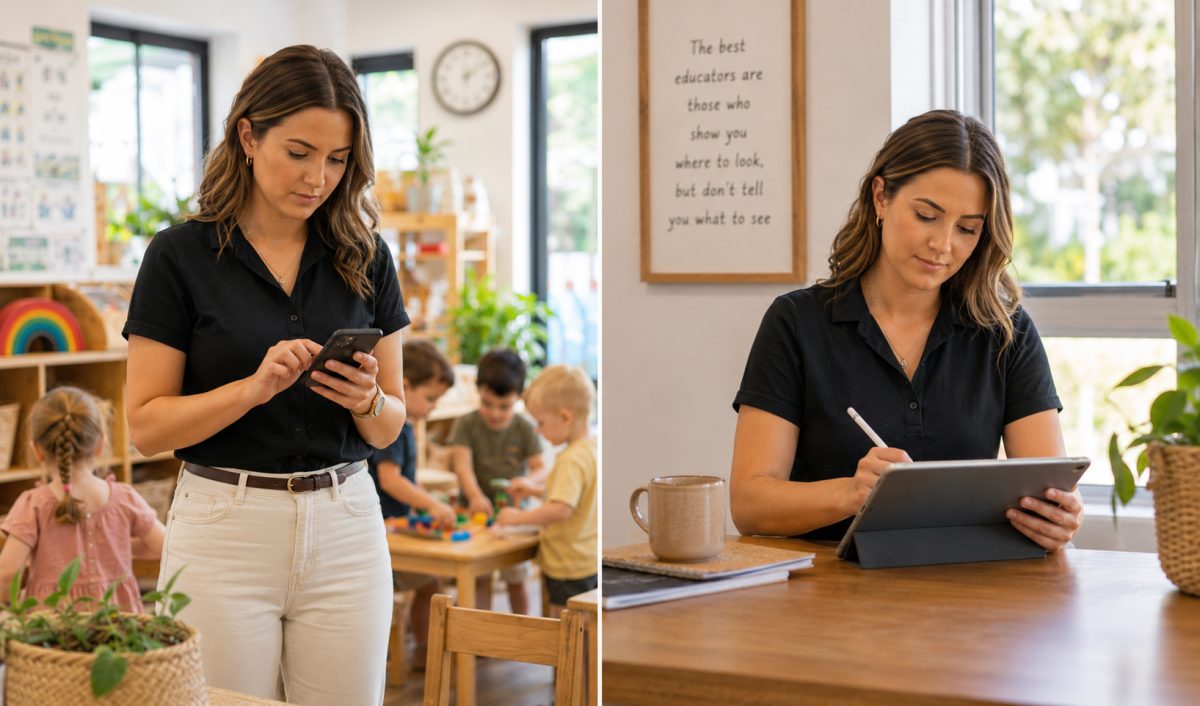
The most sustainable approach separates the observation from the write-up. In the moment, when something noteworthy happens, capture it quickly. A few sentences typed on a phone or tablet, a voice memo, a photo with a quick caption. Just enough to record what happened, what was said, and what struck you about it while it is fresh.
The write-up, where you expand the notes into a proper learning story or observation, add outcome links, and give it the care it deserves, can happen in a calmer moment later in the shift, or during protected documentation time.
This two-step approach removes the pressure of needing uninterrupted time in a busy room. The raw material is captured in the moment. The craft happens when there is space for it.
Use children's engagement windows deliberately
Throughout any given day, when children are more deeply engaged in self-directed activity and need less direct intervention from educators, oportunities to document may be captured. In long day care, outdoor play, creative activities, construction, and sensory play often create these windows. In OSHC, homework time, free choice activities, and sport or recreation sessions can offer the same opportunity, particularly once children are settled and focused.
This is also where documentation and observation intersect naturally. Watching children engaged in purposeful activity is exactly the right time to be writing about what you see. You are not stepping away from the children. You are doing the professional work of recording what their play and activity reveals about their learning.
Some of the best early childhood documentation is written in exactly these moments, unhurried, observational, and rich in specific detail because the educator was watching closely.
Turn incidental moments into documentation opportunities
Children are curious about what educators do, and this curiosity is an opportunity. When a child asks what you are writing on your tablet, that is the beginning of a genuine interaction. Explain what you are doing in age-appropriate terms. You are writing down what you noticed about them today because what they do and learn is important.
For older children in OSHC in particular, this kind of transparency supports agency and self-reflection, both valued under My Time, Our Place. School-age children who understand that their learning is being noticed and recorded often engage with the process thoughtfully and sometimes take genuine pride in it.
You can also document the interaction itself. A child asking about your documentation and the conversation that follows is a legitimate observation. In long day care it might link to EYLF Outcome 4.1 (children develop dispositions for learning such as curiosity) or Outcome 5.1 (children interact verbally and non-verbally with others for a range of purposes). In OSHC it might link to MTOP Outcome 4 (children are confident and involved learners) or Outcome 5 (children are effective communicators). The moment you thought you needed to stop documenting to deal with was actually documentation.
Set realistic, sustainable targets
Perfectionism is one of the quieter enemies of consistent documentation. Educators who feel that every piece of documentation needs to be a polished, comprehensive learning story often end up writing very little because the bar feels impossibly high.
Sustainable documentation is not about writing less. It is about writing regularly. A short, specific, honest observation completed every day or two is more valuable than an occasional comprehensive story written under pressure before an assessment visit.
If your centre is struggling with documentation frequency, start by setting a modest and realistic target. One observation per educator per day across a week adds up to a significant body of evidence over a term. One well-written learning story per child per month, sustained consistently across the year, creates a meaningful portfolio. Realistic targets that educators can actually meet build confidence and habit. As the habit solidifies, quality and depth naturally follow.
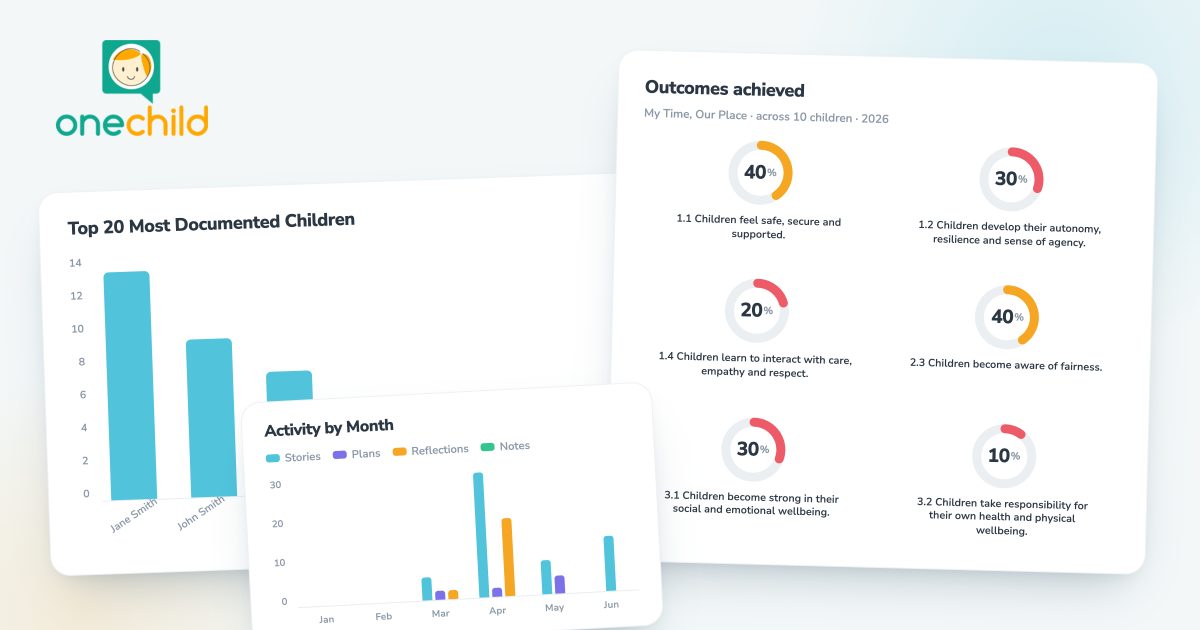
One Child's educator reporting gives directors and educational leaders a clear view of each educator's documentation output across stories, plans, reflections, and notes for the year. This makes it easy to spot who is on track, who needs support, and where the team as a whole is progressing. Managing to data rather than guessing makes these goals and subsequent conversations more productive and more fair.
Use technology to remove friction, not add it
The right documentation tool should make the process faster, not slower. If your current system requires multiple steps to complete a simple observation, generates paperwork that then needs to be filed separately, or is difficult to use on the devices your educators actually have in their hands, it is adding to the time problem rather than solving it.
A well-designed online documentation system brings everything into one place. Educators can start an observation on their phone in the moment, add photos from the same device, link to EYLF or MTOP outcomes with a few taps, and submit when they are ready. Nothing is lost, nothing needs to be reprinted, and the portfolio builds automatically.
One Child's AI-assisted learning story feature addresses one of the most time-consuming parts of documentation, the blank page. An educator can enter their observation notes and generate a draft story that they then refine and personalise. The professional judgement stays with the educator. The time spent getting from notes to a finished piece is significantly reduced.
When documentation is genuinely easier, educators do more of it. That is not a technology promise. It is what centres using One Child consistently tell us.
Documentation does not require more time. It requires better time.
The centres that document well are not the ones with the most hours available. They are the ones that have made documentation a genuine priority, built it into the structure of the day, and given their educators the tools and habits to do it efficiently and well.
Time is always going to be limited in early childhood. The strategies above are about using what you have more intentionally, so that documentation happens consistently, sustainably, and without the end-of-term scramble that costs everyone more time than the daily habit ever would.
One Child is designed to make documentation faster, easier, and more meaningful for your whole team.
Related Articles
5 reasons to move to online documentation at your early childhood centre
Still managing documentation on paper or spreadsheets? Here are five compelling reasons Australian early childhood centres are switching to...
10 June 2026
7 steps to better documentation in early childhood education
Good documentation is more than compliance. It tells the story of a child's learning journey. Here are seven practical steps to help your ed...
10 June 2026

8 ways to motivate educators to document
Documentation is a non-negotiable part of quality early childhood practice, but getting educators genuinely motivated to do it well is one o...
10 June 2026