
Educational leader: not just a title
12 June 2026
The educational leader role exists in every approved early childhood education and care service in Australia. It is a requirement of the National Quality Framework, outlined in NQS 7.2.2, which requires that the educational leader is supported and leads the development and implementation of the educational program and assessment and planning cycle.
In practice, the role often gets assigned to the most experienced or most senior educator available, with little discussion about what it actually requires. The title gets added to a position description, and the day-to-day reality of the role remains vague.
This is a missed opportunity. A genuinely effective educational leader is one of the most powerful drivers of quality in a centre. They set the standard for documentation, shape the culture around programming and reflection, build the skills of every educator on the team, and provide the professional backbone that makes a centre's educational program coherent and defensible under NQS assessment.
Here is what the role actually requires and what good educational leadership looks like in practice.
What the NQF requires
The educational leader requirement sits within NQS Quality Area 7, which covers governance and leadership. Quality Area 7 has two standards. Standard 7.1 covers governance, including service philosophy, management systems, and roles and responsibilities. Standard 7.2 covers leadership, and this is where the educational leader role sits directly.
NQS 7.2 requires that effective leadership builds and promotes a positive organisational culture and professional learning community. This is not just about having someone with the title. It is about that person actively developing the culture of the centre around professional learning, reflection, and quality practice.
NQS 7.2.2 specifically addresses educational leadership, requiring that the educational leader is supported and leads the development and implementation of the educational program and assessment and planning cycle. Importantly, the NQF does not prescribe a formal qualification for the educational leader role beyond being suitably qualified and experienced for the setting. What it does require is that the person genuinely leads, not just oversees.
NQS 7.2.3 further requires that educators, coordinators, and staff members have their performance regularly evaluated and that individual plans are in place to support their learning and development. The educational leader plays a central role in making this happen in practice.
For long day care, the educational program must be delivered in accordance with the Early Years Learning Framework V2.0, Belonging, Being and Becoming. For outside school hours care (OSHC), it must be delivered in accordance with My Time, Our Place. The educational leader is responsible for ensuring educators understand and apply the relevant framework in their documentation and programming, whichever setting they work in.
What the role actually involves
The educational leader is not simply a title given to the most experienced educator in the room. It is an active leadership role that requires consistent effort across several areas.
Leading the educational program
The educational leader is responsible for the overall coherence and quality of the centre's educational program. This means ensuring the program is genuinely responsive to the children in care, that observations and assessments feed meaningfully into planning, and that the planning cycle is understood and followed by all educators rather than existing on paper only.
In practical terms this involves reviewing the program regularly, identifying gaps in outcome coverage, ensuring that individual children's interests and developmental needs are being responded to, and guiding the team toward more intentional, responsive programming.
Building educator capability
This is arguably the most important part of the role. An educational leader who improves the documentation and programming skills of every educator in the centre multiplies their impact many times over. An educational leader who simply models good practice without sharing it or teaching it is leaving most of the value of the role on the table.
Building capability looks different in different centres. It might involve running informal training on writing quality observations, reviewing learning stories with educators and providing specific feedback, sharing examples of strong documentation with the team, or identifying professional development opportunities for individuals with particular gaps.
The goal is a team where every educator understands what quality documentation looks like, has the confidence to produce it, and receives enough feedback to keep improving. Under NQS 7.2.2, the educational leader is responsible for leading the development and implementation of the educational program and the assessment and planning cycle — and that leadership extends directly to building the professional capability of the team around it. The educational leader does not just model good practice. They create the conditions in which every educator can develop it.
Mentoring and supporting individual educators
Beyond team-wide capability building, the educational leader plays an important mentoring role with individual educators. A new or early-career educator needs guidance on how to observe meaningfully, how to link observations to framework outcomes, and how to use documentation to inform planning. An experienced educator who has developed habits that limit their documentation quality may need honest, specific feedback delivered in a way that motivates improvement rather than defensiveness.
This kind of individualised mentoring requires the educational leader to have a clear picture of where each educator is in their practice. Reviewing documentation, having regular one-on-one conversations, and setting individual development goals around documentation quality all support this.
Driving reflective practice
Reflective practice sits at the heart of quality early childhood practice. NQS 1.3.2 requires that critical reflection on children's learning and development — both as individuals and in groups — drives program planning and implementation, and the educational leader is primarily responsible for embedding that culture of reflection across the centre. Reflection is not just a section at the bottom of a learning story form. It is a professional habit of questioning what happened, why it happened, what it reveals about children's learning, and what should change as a result.
In centres with strong educational leadership, reflection happens in team meetings, in informal conversations between educators, in the way documentation is reviewed and discussed, and in the planning decisions that follow. The educational leader models reflective thinking openly and creates space for others to do the same.
Ensuring quality documentation across the centre
The educational leader has a direct responsibility for the quality of documentation produced at the centre, not just their own but everyone's. This means having a process for reviewing documentation regularly, identifying patterns in quality across the team, and addressing those patterns through support, feedback, and training.
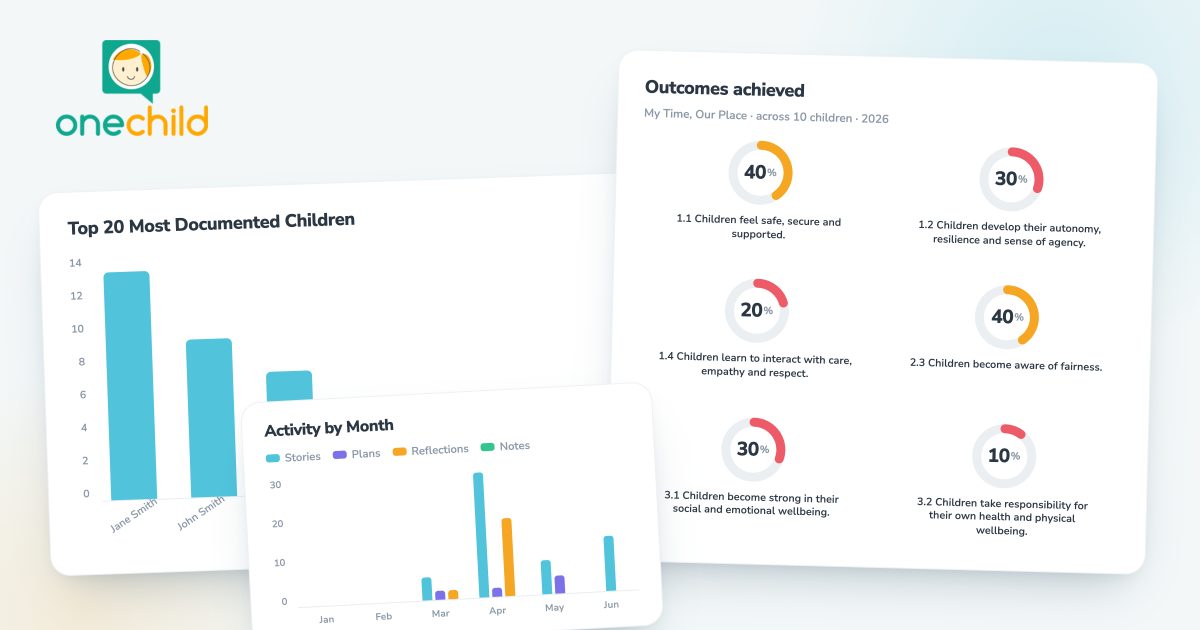
One Child makes this practical. The curriculum overview shows the educational leader which EYLF or MTOP outcomes are being covered across the centre and which are underrepresented. The educator reporting tools show each educator's documentation count across stories, plans, reflections, and notes, making it easy to spot who is documenting regularly and who may need support or accountability. The most and least documented children report ensures that no child is being overlooked in the programming cycle.
With this kind of visibility, an educational leader can have informed, specific conversations with educators rather than general ones. Rather than saying "we need more documentation," they can say "I noticed Outcome 3 is underrepresented in our stories this term, let's talk about how we might address that" or "I can see that three children in the toddler room have not had a story in the past six weeks, what is getting in the way?"
What makes a good educational leader
Beyond the formal requirements, certain attributes consistently distinguish educational leaders who make a genuine difference from those who hold the title without the impact.
Passion for curriculum and children's learning. An educational leader who is genuinely interested in how children learn, what the frameworks say, and how documentation and programming connect to development brings an energy to the role that is hard to manufacture. Educators follow someone who clearly cares about the work.
Approachability. The educational leader needs to be someone educators feel comfortable bringing questions, uncertainties, and drafts to. A leader who responds to imperfect documentation with criticism rather than guidance creates a culture of avoidance rather than improvement.
Strong framework knowledge. For long day care, this means a deep and current understanding of EYLF V2.0, its five outcomes, its principles, and its practice elements. For OSHC, it means the same level of understanding of My Time, Our Place. The educational leader should be the person in the centre others go to when they have a question about what the framework requires or how to apply it.
Willingness to model the work. An educational leader who is seen documenting, reflecting, and engaging with the planning cycle sets a standard by example. One who delegates documentation to others while doing little themselves has no credibility in developing that practice across the team.
Consistency. Educational leadership is not an occasional intervention. It is a consistent, ongoing presence in the professional life of the centre. Regular feedback, regular reflection, regular review of the program. The impact of educational leadership is cumulative.
Investing in the role
Too many early childhood centres treat the educational leader role as an administrative formality, a box to tick on the NQF checklist. The centres that get the most out of the role are those that invest in it deliberately: giving the educational leader protected time to review documentation and provide feedback, supporting them with professional development around leadership and curriculum, and holding them accountable for the quality outcomes their role is designed to produce.
The investment repays itself many times over. A centre with a genuinely effective educational leader has better documentation, stronger programming, more confident educators, and a stronger position under NQS assessment. The educational leader does not just hold a title. They hold the standard.
How One Child supports educational leaders
One Child gives educational leaders the visibility and tools to do their job well. Review every educator's documentation from a single dashboard. Use the curriculum overview to identify gaps in outcome coverage. See at a glance which children are being documented regularly and which have not had a story recently. Provide feedback directly within the platform.
The educational leader role is about professional leadership. One Child handles the data so the leader can focus on the people.
Want to see how One Child supports educational leaders in your centre?
Related Articles
5 reasons to move to online documentation at your early childhood centre
Still managing documentation on paper or spreadsheets? Here are five compelling reasons Australian early childhood centres are switching to...
10 June 2026

7 steps to better documentation in early childhood education
Good documentation is more than compliance. It tells the story of a child's learning journey. Here are seven practical steps to help your ed...
10 June 2026

8 ways to motivate educators to document
Documentation is a non-negotiable part of quality early childhood practice, but getting educators genuinely motivated to do it well is one o...
10 June 2026