What is play-based learning, and what does it look like in OSHC?
07 November 2026 · 10 min read
Play-based learning is an approach where children learn through play rather than through direct instruction. They explore, test ideas, solve problems, and make sense of their world by engaging with people, objects, and each other, while educators support and extend that learning with intention rather than taking it over. In outside school hours care, this sits at the heart of My Time, Our Place, which frames children's time in care as play and leisure that complements their learning at home and school.
Most explanations of play-based learning are written for preschool and long day care. That leaves OSHC educators reading about three-year-olds in a sandpit and wondering how any of it applies to a room full of nine-year-olds who have just spent six hours at school. It does apply, but it looks different. This guide is written with a focus on OSHC educators, but we haven't forgotten about long day care either.
What play-based learning actually means
The Early Years Learning Framework describes play-based learning as "a context for learning through which children organise and make sense of their social worlds, as they engage actively with people, objects and representations". Let's unpack what this actually means for children and educators.
Learning is the point, and play is the vehicle. A child stacking blocks is testing balance, negotiating with a friend about whose turn is next, and learning to try again when the tower falls. Play-based learning recognises that as real learning.
The child leads, and the educator is deliberate. A common myth is that play-based learning means educators step back and let children do whatever they want. That's not it. The educator acts deliberately, thoughtfully, and purposefully to support and stretch the learning, while leaving authentic choice and control with the child. Both the child and the educator bring intention to the play.
Play also builds dispositions. Curiosity, resilience, concentration, creativity, and cooperation are the habits of a learner, and they're hard to teach through instruction. Children develop them by playing.
What changed in V2.0
Free download
80 activities, mapped to the frameworks you already use
Free download: 80 activities mapped to EYLF v2.0 and MTOP v2.0 outcomes — ready to use this week.
The national frameworks were updated to Version 2.0 in 2022, and services began using them from 2023. In the EYLF, the two practices previously called "Learning through play" and "Intentional teaching" were combined into one practice, "Play-based learning and intentionality".
Putting them in the same practice makes the point that educator intention and child-led play work together. You can be deliberate about children's learning and still let them direct their own play.
Why OSHC is different
School-age care is not an extension of the school day. My Time, Our Place says children's learning in school age care complements their learning at home, at school, and in the community. The focus is on children taking an active part in play, leisure, and recreation.
Children arrive at your service after a structured, directed day at school. They don't need more of the same. They need space to choose what they do, to rest, to muck about with friends, to run around, and to make things. My Time, Our Place protects that, and it values play for its own sake, not only play that can be tied neatly to a learning goal.
My Time, Our Place is the approved learning framework for school-age education and care, covering before and after school care, vacation care, and other school-age settings. Like the EYLF, it's built on the vision of Belonging, Being and Becoming, and it has five learning outcomes. Children and young people have a strong sense of identity, are connected with and contribute to their world, have a strong sense of wellbeing, are confident and involved learners, and are effective communicators. The difference is that MTOP frames these outcomes around play, leisure, and the growing independence of older children.
Play, leisure and intentionality in MTOP
MTOP V2.0 made its own version of the same change. The practice is now called "Play, leisure and intentionality", and it recognises two kinds of intentionality, the educator's and the child's or young person's.
This is where OSHC educators can breathe out. Intentionality in school-age care doesn't mean constant adult direction. Not every moment needs to be a planned activity, and not every game needs steering toward an adult's goal. Over-directing OSHC can smother what makes it valuable, like children's agency, their friendships, rest, humour, and time that feels different from school.
Say a group of children invent a trading game with bottle caps. Instead of taking it over, you make sure there are enough caps, ask a question that nudges their thinking, and step back. Each of those was a deliberate choice, made to support the children's play.
What it looks like in practice
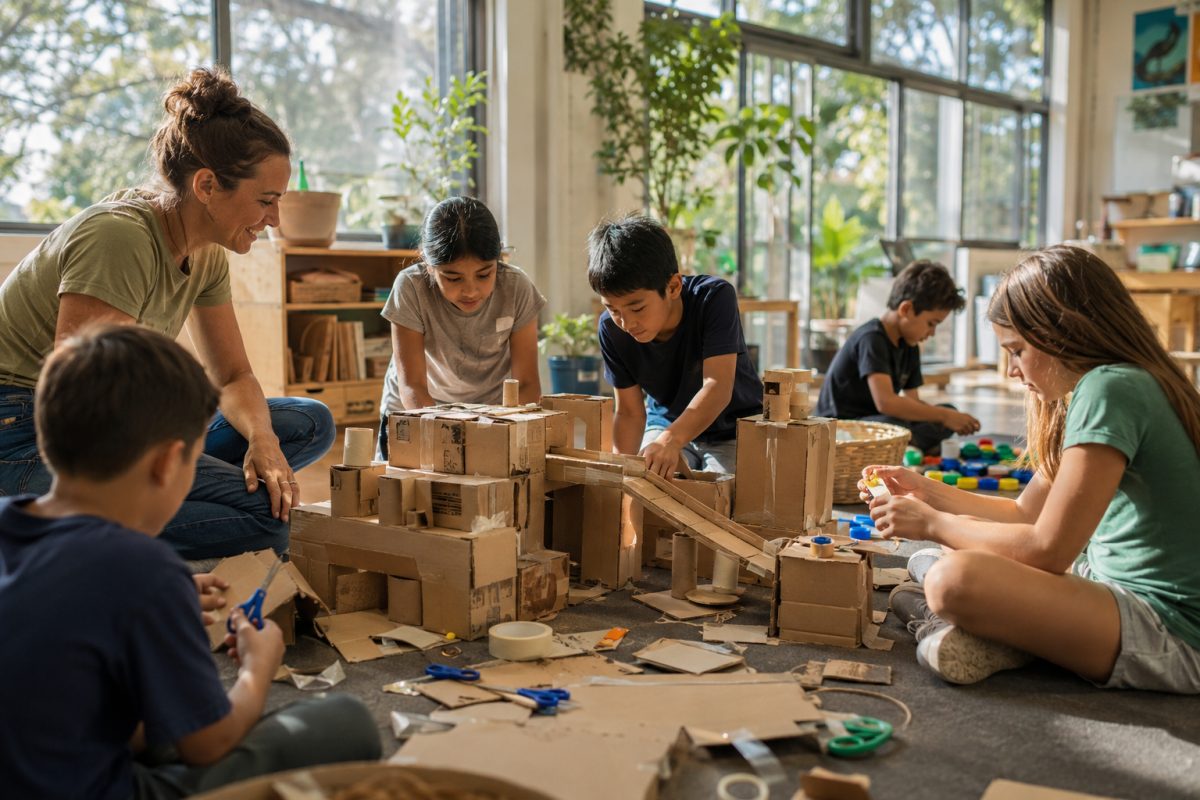
A vacation care group spends most of a morning building a cardboard city. They argue about where the roads should go, work out how to make a bridge hold weight, split up the jobs, and find a role for a younger child who wants to help. Problem solving, collaboration, and inclusion all came out of play the children chose themselves.
After school, a couple of ten-year-olds run a card tournament that goes on for weeks. They set the rules, settle disputes, and change the format when it isn't working. Nobody asked an adult to run it, and they're learning about leadership and fairness by doing it.
A child who finds the shift from school hard is given a quiet corner with drawing materials and no pressure to join in. Nothing gets produced and no outcome is taught, but it supports their wellbeing and sense of belonging, and that counts.
In long day care the same principles show up with younger children. A three-year-old lining up shells by size is exploring early maths. Two toddlers cooking an imaginary dinner in the home corner are practising language, turn-taking, and empathy. An educator who adds a real measuring cup to the shell play, or asks what's for dinner, is being intentional without taking over.
How to document play-based learning without killing it
This is where a lot of OSHC educators feel the pinch. You can see the learning in the play, but writing it all up threatens to turn a relaxed environment into a paperwork factory.
Document to make learning visible, not to prove you were busy. ACECQA's documentation guidance says authorised officers look at how documentation is used to support the educational program, not how much of it there is. It also asks services to consider whether their documentation is taking time away from children. A handful of meaningful records beats a mountain of thin ones.
Capture the child's intentionality as well as yours. Good school-age documentation shows the choices children made and the thinking behind their play, alongside the decisions you made to support it. That's the Play, leisure and intentionality practice in action.
Know where it sits in the National Quality Standard. In school-age care, documenting the educational program connects to NQS Standard 1.1 (Program) and Standard 1.3 (Assessment and planning), and to Regulations 73 and 74 of the National Regulations. Requirements for children over preschool age vary by state and territory. In most places, services no longer have to document individual evaluations of school-age children, but the ACT still requires them and WA has its own provisions, so check the rules where you are.
The best documentation often starts as a rough note jotted while the play is still happening. The skill is turning that note into something readable later, without losing the moment or spending your whole afternoon on it.
One Child's AI Writing Assistant helps with that step. You enter your observation notes and it drafts a learning story, so you're not starting from a blank page. You then shape it, add the detail only you saw, choose the outcomes that fit, and make it your own. Children's first names are removed before your notes go to the AI and put back afterwards, so real names aren't sent to the model. The tool doesn't decide what the play meant. You do.
Getting the balance right
Play-based learning belongs in school-age care as much as it does in preschool, and My Time, Our Place puts play, leisure, choice, and children's growing independence at the centre of it. Be intentional without taking over, protect the freedom that makes OSHC different from school, and keep your documentation light but meaningful. That gives you a program that serves the children in front of you and stands up when your service is assessed.
Frequently asked questions
Is play-based learning only for preschool and long day care?
No. Play-based learning applies from birth right through the primary school years. In long day care it's guided by the Early Years Learning Framework, and in outside school hours care it's guided by My Time, Our Place, which frames children's time as play and leisure that complements school. The principles are shared, but what it looks like changes with the age and needs of the children.
Does play-based learning mean educators just let children do whatever they want?
No, and it's the most common misunderstanding. Play-based learning pairs authentic child-led play with educator intentionality. The educator acts deliberately to support and extend learning while leaving real choice and control with the child. Deciding to step back at the right moment can be one of those deliberate choices.
What is the difference between EYLF and MTOP for play?
Both frameworks share the Belonging, Being and Becoming vision and have five learning outcomes across the same themes. The Early Years Learning Framework covers children from birth to five and their transition to school. My Time, Our Place covers school-age children and centres on play, leisure, recreation, and independence, with OSHC complementing school rather than extending it.
What does intentionality mean in outside school hours care?
It means making thoughtful decisions to support children's play, leisure, and wellbeing. In OSHC it doesn't mean constant adult direction or turning every moment into a planned activity. Often it's providing the right resources, asking a well-timed question, or choosing to step back so children can lead their own play.
How much do I need to document in OSHC?
Enough to make children's learning and your decisions visible, and no more. ACECQA's guidance focuses on how documentation is used, not how much there is. In school-age care, documentation connects to NQS Standards 1.1 and 1.3 and Regulations 73 and 74. Most states and territories no longer require individual evaluations of school-age children, but the ACT does and WA has its own provisions.
Can a tool help me document play-based learning?
Yes, as long as it supports your judgement rather than replacing it. One Child's AI Writing Assistant turns your observation notes into a draft learning story, and you edit, personalise, and finish it. Children's names aren't sent to the AI. You still decide what the play meant and which outcomes it shows.
Related articles
References
ACECQA. (2023). Documenting programs for school age services. https://www.acecqa.gov.au/sites/default/files/2023-06/DocumentingProgram.pdf
ACECQA. (2023). Information sheet: MTOP Practices, Play, leisure and intentionality. https://www.acecqa.gov.au/sites/default/files/2023-07/InformationSheet_MTOP-Practices%20%E2%80%93%20Play%2C%20leisure%20and%20intentionality.pdf
ACECQA. (2025). QA1 Educational program documentation for educators, school age care. https://www.acecqa.gov.au/node/1107956
Australian Government Department of Education. (2022). Belonging, Being and Becoming: The Early Years Learning Framework for Australia V2.0. [ADD URL]
Australian Government Department of Education. (2022). My Time, Our Place: Framework for School Age Care in Australia V2.0. https://www.acecqa.gov.au/sites/default/files/2023-01/MTOP-V2.0.pdf
Free download
80 activities, mapped to the frameworks you already use
Free download: 80 activities mapped to EYLF v2.0 and MTOP v2.0 outcomes — ready to use this week.
More in OSHC Documentation
View all OSHC Documentation articles →
Finding time to document for the NQF
Time is the number one reason Australian early childhood educators give for not documenting. Here are practical, realistic strategies to hel...
30 Jul 2026 · 9 min read

Observation basics: a guide for early childhood educators
Observations are the foundation of quality early childhood documentation. This guide covers what to observe, how to write it well, the diffe...
30 Jul 2026 · 10 min read

Educational leader: not just a title
The educational leader role is one of the most important in any early childhood centre, but it is also one of the most misunderstood. Here i...
30 Jul 2026 · 9 min read